


AI at the Frontlines · Season 5 · Part VI — Leading the AI-Native Enterprise
~7-minute read
Editor’s Note
In Part V, Decision Boundaries, I explored a question that becomes increasingly important as AI moves from recommendation into execution:
Under what conditions should decision authority shift?
But once some authority does shift, another question follows:
What becomes the leader’s job?
Traditional operating models distribute responsibility through layers of human coordination.
Leaders set intent.
Managers translate intent into priorities.
Teams execute and make operating decisions.
Exceptions escalate.
Leaders review outcomes and adapt.
AI increasingly participates in the middle of that chain.
It can coordinate workflows.
Recommend actions.
Make bounded decisions.
Execute approved actions.
Monitor outcomes.
That does not make leadership less important.
It changes where leadership creates value.
What Leaders Need to Know
Intent becomes more important.
AI can optimize execution, but leaders still determine the outcomes, priorities, constraints, and trade-offs that matter.
Authority must be designed.
Delegation requires explicit boundaries, thresholds, controls, evidence, and escalation conditions.
Oversight shifts from activity toward system behavior.
Leaders need visibility into outcomes, exceptions, overrides, and emerging patterns — not necessarily every individual action.
Human judgment should remain closest to decisions where ambiguity and consequence are highest.
The leadership challenge is therefore not simply to supervise more capable technology.
It is to redesign the operating environment around it.
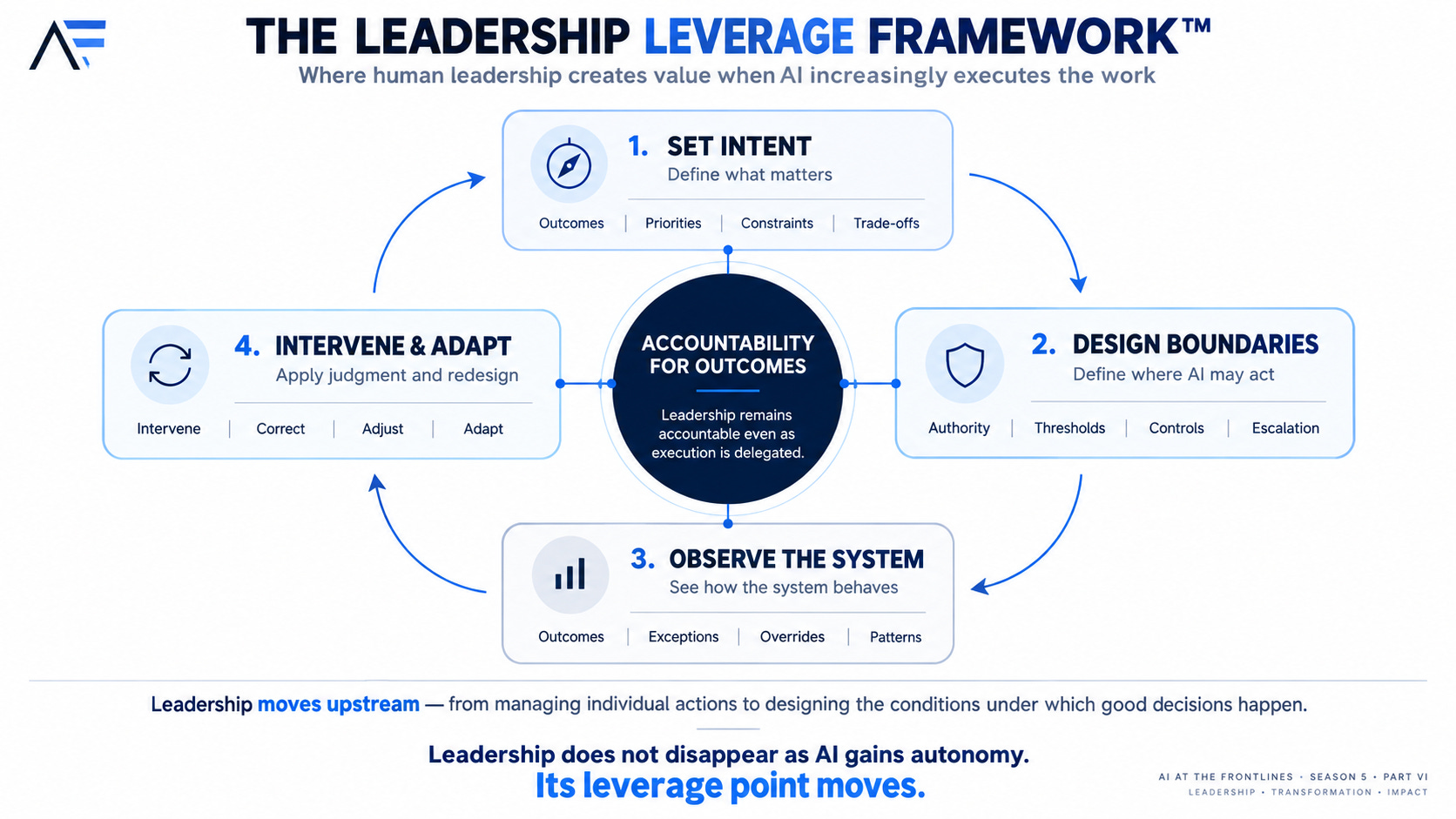
The Leadership Leverage Framework™
If intelligent systems increasingly participate in execution, where should leadership concentrate its attention?
I see four responsibilities becoming increasingly important:
Set Intent → Design Boundaries → Observe the System → Intervene & Adapt
At the center sits:
Accountability for Outcomes
The four responsibilities form a continuous leadership loop.
Leaders define the intent.
They determine the authority boundaries within which people and AI operate.
They observe how the system behaves against intended outcomes.
And they intervene when judgment is required — adapting the objective, boundary, control, or operating model as conditions change.
Accountability sits at the center because delegation does not remove responsibility for outcomes.
The objective is not to keep leadership involved in every action.
It is to concentrate leadership where it creates the greatest leverage.
The underlying principle is:
Leadership moves upstream — from managing individual actions to designing the conditions under which good decisions happen.
And as AI gains more autonomy:
Leadership does not disappear. Its leverage point moves.
From Managing Actions to Designing the System
When humans perform most of the work, leadership naturally sits close to execution.
A proposal is reviewed.
A decision is authorized.
An exception is escalated.
An outcome is checked.
That model works when the number and speed of decisions remain manageable.
But imagine an enterprise where hundreds of intelligent systems participate in thousands of operational decisions.
If every meaningful action still waits for a leader, the organization may increase AI capability without increasing organizational speed.
The leadership question therefore changes.
Instead of asking:
Which decisions should I personally approve?
leaders may increasingly need to ask:
What conditions should exist so the right decisions can happen without requiring me to approve every one?
That is a different leadership discipline.
From Hierarchy to Leadership Architecture
Traditional organizations often distribute authority through hierarchy.
When uncertainty appears, a question moves upward until it reaches someone with sufficient authority.
AI creates another possibility.
Some authority can increasingly be designed into the operating environment through permissions, thresholds, decision boundaries, execution controls, escalation rules, and observability.
This does not eliminate hierarchy.
But it can reduce the need for hierarchy to participate in every transaction.
Leadership therefore begins moving from being the decision point toward designing the decision architecture.
That distinction matters.
A leader who personally resolves every exception may appear highly involved.
But a leader who designs a system that handles routine situations appropriately — while surfacing the exceptions requiring human judgment — may create far greater organizational leverage.
1. Set Intent
AI systems can optimize.
But leaders still determine what should be optimized for.
Speed?
Customer experience?
Cost?
Resilience?
Risk reduction?
Growth?
Those objectives frequently compete.
A system can execute flawlessly against the wrong objective if organizational intent is unclear.
Leadership therefore begins by defining:
the outcome
the priority
the constraints
the acceptable trade-offs
and what must not be optimized away
The more execution becomes distributed, the more important clarity of intent becomes.
Setting intent is no longer simply a communication exercise.
It becomes part of the operating architecture.
2. Design Boundaries
Intent tells the organization where to go.
Boundaries determine how far AI is allowed to go.
Which decisions may AI make?
Which should it recommend?
Which require approval?
When must the system escalate?
Part V focused on these Decision Boundaries.
The core principle was:
The matrix classifies the decision.
The boundary determines who gets to act.
That now becomes part of the leader’s operating responsibility.
Delegation to AI should not happen simply because the technology is capable.
Capability answers what AI can do.
Authority determines what it is allowed to do.
And one governance principle remains important:
No delegated authority = no autonomous action.
3. Observe the System
Traditional supervision often focuses on individual activity.
Who did what?
Was the task completed?
Was the process followed?
As execution becomes increasingly distributed across humans and AI, leaders may need to move from watching individual actions toward observing system behavior.
Are outcomes improving?
Where are exceptions increasing?
Where are people repeatedly overriding AI recommendations?
Which boundaries are being reached most frequently?
Are systems optimizing locally while creating enterprise-level problems?
Are outcomes moving away from organizational intent?
The objective is not to watch every decision.
It is to remain able to see when the system begins moving in the wrong direction.
In an AI-native enterprise, observability is therefore not only a technology capability.
It increasingly becomes a leadership capability.
4. Intervene & Adapt
Human judgment does not disappear.
It becomes concentrated where it matters most.
Novel situations.
Conflicting objectives.
High-consequence decisions.
Ethical trade-offs.
Strategic ambiguity.
Unexpected system behavior.
Leadership therefore becomes partly about knowing when to enter the loop.
Sometimes the right intervention is to override a decision.
But often the more valuable intervention is to:
redesign the boundary
change the objective
modify the control
adjust the threshold
or redesign the operating model
That is the difference between fixing one decision and improving the system that produces decisions.
And the loop then begins again.
New evidence may require new intent.
Changed conditions may require new boundaries.
Observed behavior may require intervention.
Leadership therefore becomes continuous and adaptive.
Accountability Does Not Require Constant Approval
This may be one of the hardest leadership shifts.
Organizations often equate accountability with approval.
If a leader is accountable, the assumption is that the leader should personally approve the action.
But those are different concepts.
Approval is participation in a specific decision.
Accountability is responsibility for the outcomes, controls, and operating environment in which decisions occur.
A leader can remain accountable for outcomes while delegating execution — provided intent, authority, controls, evidence, and escalation are clearly designed.
This distinction matters because human approval does not scale indefinitely.
As AI participates in more decisions, keeping leaders in every loop can recreate the coordination bottleneck the technology was intended to remove.
The question becomes:
How do we preserve accountability without requiring constant participation?
That is why Accountability for Outcomes sits at the center of the Leadership Leverage Framework™.
It is not another stage.
It is the enduring responsibility connecting all four.
Three Leadership Failure Modes
The transition can fail in predictable ways.
Over-supervision
AI gains capability, but every meaningful action still requires human approval.
The technology changes.
The operating model does not.
Over-delegation
Authority expands faster than evidence, controls, or accountability.
The organization gains speed but loses confidence.
Under-observation
Leaders step away from individual actions without building mechanisms to understand system-level behavior.
Autonomy increases.
Visibility decreases.
The objective is not to choose between autonomy and control.
It is to design an operating model in which both can scale together.
Consider Major Incident Management
Imagine a critical enterprise service disruption.
AI detects degradation.
It correlates signals across systems.
It identifies probable causes.
It opens collaboration channels.
It runs approved diagnostics.
It recommends recovery actions.
And within predefined boundaries, it may execute certain remediation steps.
Where does leadership create value?
Not by approving every diagnostic action.
Leadership creates value by determining:
What business outcome takes priority?
What level of risk is acceptable?
Which remediation actions may proceed within defined boundaries?
What requires human authorization?
When should customer impact outweigh technical optimization?
When has the situation moved outside the original decision boundary?
When should the response strategy change entirely?
AI may increasingly manage parts of execution.
Leadership remains responsible for defining the operating context.
That is the distinction.
From Management Presence to Management Leverage
In traditional operating models, leadership presence is often visible through participation.
The leader attends the meeting.
Reviews the proposal.
Approves the request.
Resolves the escalation.
Signs off on the outcome.
In an AI-native operating model, some of those visible acts may occur less frequently.
But reduced participation does not necessarily mean reduced leadership.
The leader may have created greater leverage upstream.
By defining the objective.
By designing the authority boundary.
By establishing evidence requirements.
By making exceptions observable.
By determining when escalation is required.
By ensuring the system can be corrected when conditions change.
This is why leadership in an AI-native enterprise may become less about being present in every decision and more about shaping the conditions under which decisions are made.
The Leadership Shift
The traditional center of gravity has often been:
Direct.
Decide.
Approve.
Review.
The AI-native leadership model may increasingly shift toward:
Set intent.
Design boundaries.
Observe the system.
Intervene and adapt.
This does not make leaders passive.
The work becomes more architectural.
Leadership increasingly shapes the environment in which decisions occur rather than participating in every decision itself.
A Question for the Leadership Team
Imagine that intelligent systems eventually participate in a meaningful share of enterprise execution.
Which leadership activities should remain fundamentally human?
Which should become increasingly automated?
Which should move from direct participation toward oversight?
Where should authority remain fixed?
Where should it expand as evidence improves?
And which new leadership responsibilities will emerge because intelligent systems are participating in execution?
Those are not primarily technology questions.
They are organizational design questions.
Leadership teams may need to answer them before technology answers them by default.
Final Thought
AI-native leadership is not about stepping out of the loop.
It is about becoming more deliberate about where leadership should enter it.
AI can increasingly coordinate.
AI can recommend.
AI can act.
Within defined boundaries, AI can increasingly decide.
But leaders still determine:
what the organization is trying to achieve
how much authority should be delegated
what evidence is sufficient
where the limits are
what outcomes matter
and when human judgment must intervene
Leadership does not disappear as AI gains autonomy.
Its leverage point moves.
The shift may look like this:
From supervising activity
to designing operating conditions.
From approving decisions
to defining decision environments.
From managing individual actions
to governing outcomes.
From being in every loop
to knowing when judgment matters most.
So where should human leadership create the greatest leverage?
Where intent, trade-offs, boundaries, accountability, and judgment must be defined — not in routine execution itself.
The greatest leadership leverage will not come from being in every decision.
It will come from designing the environment in which the right decisions can happen — and knowing when human judgment must enter the loop.
Continue the Series
Season 5 · Leading the AI-Native Enterprise
Part I — The AI-Native Enterprise
How enterprise transformation changes when AI becomes part of the operating model.
Part II — The Enterprise Coordination Shift™
How AI changes how work moves across the enterprise.
Part III — Enterprise Trust Architecture™
How autonomy can scale without losing control.
Part IV — Human + AI Execution Models
How responsibility can shift dynamically between humans and intelligent systems.
Part V — Decision Boundaries
How enterprises determine where AI should decide, recommend, wait for approval, or escalate.
Part VI — Leadership in the AI-Native Enterprise
How leadership changes when intelligent systems increasingly participate in execution.
AI at the Frontlines
Leadership · Transformation · Impact
Ideas. Frameworks. Insights. Impact.