


Editor’s Note: In Part IV, Human + AI Execution Models, I explored how responsibility can shift dynamically between humans and intelligent systems across the execution cycle.
But once AI is allowed to act, another question becomes unavoidable:
Who decides what AI gets to decide?
AI systems are becoming capable of doing more than generating answers.
They can interpret context, recommend actions, coordinate workflows — and increasingly, make decisions and act on them.
But capability creates a different management question:
Just because AI can make a decision, should it be allowed to?
That distinction matters.
Capability answers what AI can do.
Decision rights determine what AI is allowed to decide.
What Leaders Need to Know
Decision context comes first. Ambiguity and risk help determine what kind of decision is being made.
Authority comes next. AI may decide, recommend, wait for approval, or escalate.
Human oversight should be intentional friction. Decision boundaries can expand — or contract — as evidence grows.
Start With the Decision Context
Recent MIT CISR research offers a useful way to simplify the problem.
Its AI Decision Matrix evaluates decisions using two dimensions:
Ambiguity — how clearly the available information determines the answer.
Risk — what happens if the decision is wrong.
Together, they create four decision contexts:
Routine — low ambiguity, low risk
Exploratory — high ambiguity, low risk
Consequential — low ambiguity, high risk
Strategic — high ambiguity, high risk
The key insight is simple:
Different decision contexts require different combinations of human and AI participation.
MIT’s research notes that routine decisions are stronger candidates for automation, while strategic decisions require stronger human leadership and oversight. Human involvement remains important across the categories, but the role changes.
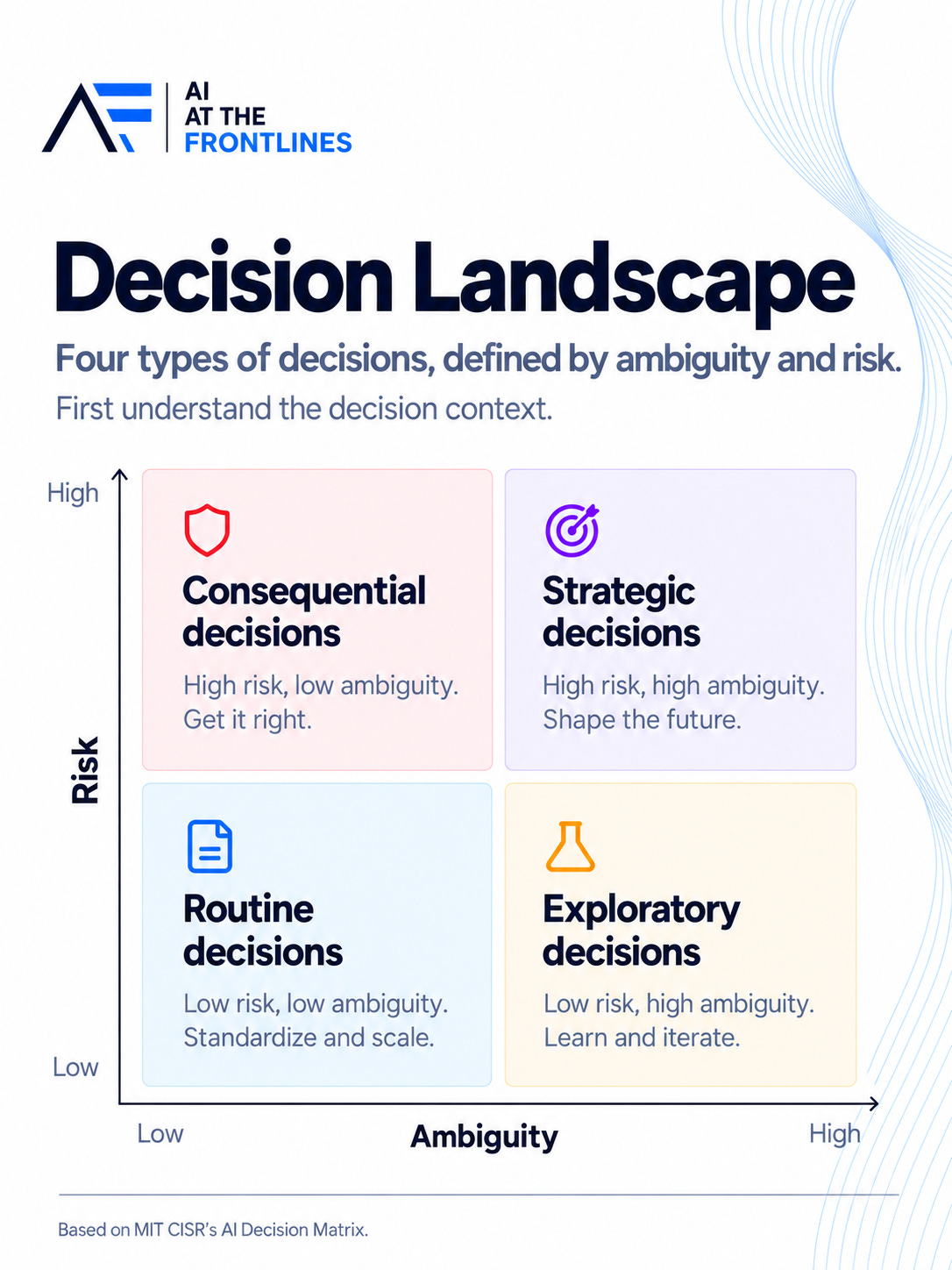
Figure 1. Decision Landscape — Four types of decisions, defined by ambiguity and risk. Based on MIT CISR’s AI Decision Matrix.
That framing moves the conversation from:
“Is AI capable enough?”
toward:
“What kind of decision are we asking AI to make?”
But enterprise execution requires one more step.
Set the Decision Boundary
Once the decision context is understood, leaders still need to determine:
What authority should AI actually receive?
Four operating postures help translate decision context into execution authority.
DECIDE
AI acts within explicitly delegated boundaries.
RECOMMEND
AI analyzes and proposes; humans frame, judge, and choose.
APPROVE
AI may prepare or initiate the action, but an authorized human approves execution.
ESCALATE
AI stops and transfers responsibility when the situation exceeds its boundaries.
The matrix classifies the decision.
The boundary determines who gets to act.
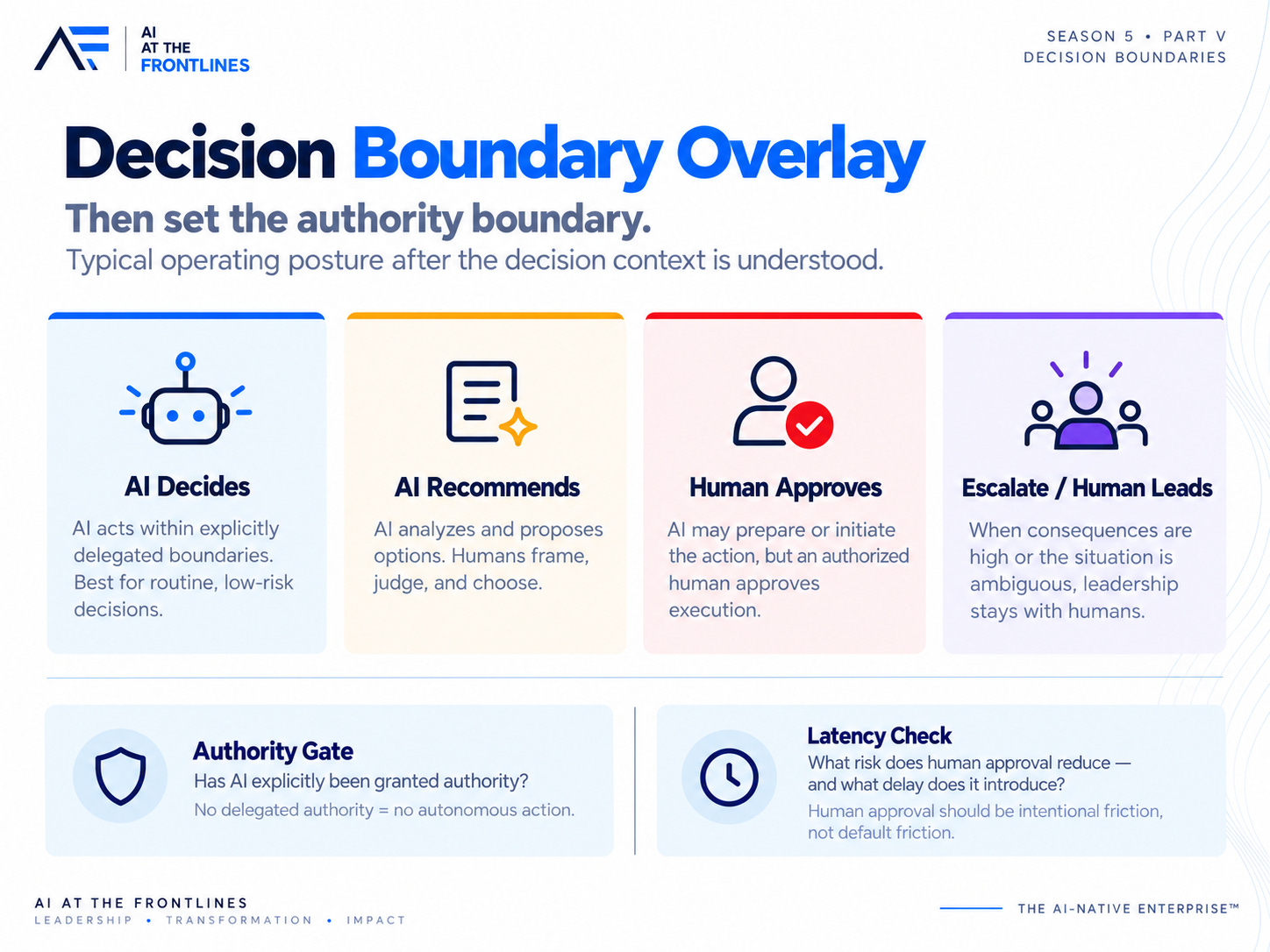
Figure 2. Decision Boundary Overlay — Typical operating posture after the decision context is understood.
These are not rigid mappings to the four MIT quadrants.
They are boundaries enterprises design based on context, controls, evidence, and risk tolerance.
A routine decision may begin in recommendation mode while a new agent is being validated.
A consequential decision may allow automation for some actions but require human approval for others.
A strategic decision may use AI heavily for analysis while keeping framing and final authority firmly human.
And beneath the entire model sits one non-negotiable rule:
No delegated authority = no autonomous action.
Technical capability does not create organizational permission.
Authority has to be deliberately granted through policy, permissions, architecture, operating rules, and accountability.
This connects directly to the Enterprise Trust Architecture™ from Part III.
Decision boundaries need to be enforceable, not merely documented.
Human Approval Is Not Free
Human approval is often treated as a safeguard by default.
But every approval gate introduces latency.
Paul Cheek, in No One Works Here, argues that organizations can create human bottlenecks when people remain in the loop for decisions machines could make faster. He also describes a temporary “reliability tax”: when an agent is first deployed, organizations may spend more time validating its output before they have enough evidence to expand its autonomy.
Cheek’s Ferrari-engine-in-a-horse-drawn-carriage metaphor captures the broader problem well: adding powerful AI to an unchanged operating model may leave the enterprise constrained by the old process.
That creates a useful management test:
What risk does human approval reduce — and what delay does it introduce?
Sometimes slowing the system is exactly the right control.
But in other situations, delay creates its own cost — slower customer response, missed windows, longer recovery, or simply a new approval bottleneck.
Human approval should be intentional friction — not default friction.
The Reliability Tax in Practice
Consider an AI agent handling routine customer service credits.
The policy is clear.
The customer facts are available.
The financial exposure is limited.
The agent may already be technically capable of deciding whether a small credit fits policy.
But when the system is first deployed, the organization may still require:
AI recommends → Human reviews → Human approves → Action executes
At first, the AI-enabled process may actually be slower.
That does not necessarily mean the system has failed.
It may mean the organization is paying the reliability tax — spending extra time validating the agent before increasing its authority.
The important question is what happens next.
As evidence accumulates, leaders can monitor accuracy, override rates, policy exceptions, customer outcomes, fraud or leakage, and time to resolution.
If reliability remains strong, the boundary can move from:
AI recommends → Human approves
to:
AI decides within defined limits → Humans monitor exceptions
And if reliability deteriorates, the boundary can contract again.
Autonomy should be earned through evidence, not assumed through capability.
A useful progression is:
Start with validation.
Earn confidence through evidence.
Expand autonomy within boundaries.
Contract the boundary when reliability falls.
This makes autonomy dynamic rather than binary.
The question is no longer:
“Should humans stay in the loop?”
It becomes:
What evidence should AI have to earn before the loop can change?
Boundaries Should Move With the Decision
Decision boundaries are not simply labels assigned once to a process.
They can shift as the situation changes.
Take the same customer-service agent operating under a defined autonomous-credit limit.
A straightforward request with complete information may remain inside the AI Decides boundary.
A request with conflicting account information may move into AI Recommends.
A larger credit may require Human Approval.
A suspected fraud pattern may trigger Escalation.
What changed was the decision context — and therefore the authority boundary.
That is the practical connection between Part IV and Part V.
Part IV asked:
Where should human judgment enter the execution loop?
Part V asks:
Under what conditions should decision authority shift?
The Leadership Question
Organizations have always designed authority.
Employees have spending limits.
Managers have approval thresholds.
Operational teams have escalation paths.
AI does not remove that responsibility.
It expands it.
Leaders may increasingly become accountable not only for individual decisions, but for designing the boundaries within which intelligent systems are allowed to decide.
That changes the management question from:
“Did I approve this decision?”
to:
“Did we design the right decision boundary?”
That is a fundamentally different leadership responsibility.
The objective is not maximum autonomy.
It is appropriate authority.
Final Thought
The AI-native enterprise will not scale by giving AI unlimited decision authority.
Nor will it scale if every meaningful action eventually waits for a person.
The more durable model sits between those extremes.
Understand the decision context.
Set the authority boundary.
Validate the system.
Expand autonomy when evidence supports it.
Contract the boundary when conditions change.
Because once AI can act, the defining question is no longer simply:
What can AI do?
It becomes:
Who decides what AI gets to decide?
Continue the Series
This is Part V of Season 5 — Leading the AI-Native Enterprise.
Part I — The AI-Native Enterprise
Why enterprise transformation changes when AI becomes part of the operating model.
Part II — The Enterprise Coordination Shift™
How AI changes how work moves across the enterprise.
Part III — Enterprise Trust Architecture™
How autonomy can scale without losing control.
Part IV — Human + AI Execution Models
How responsibility can shift dynamically between humans and intelligent systems.
Part V — Decision Boundaries
How enterprises determine where AI should decide, recommend, wait for approval, or escalate.
Coming Next — Part VI: Leadership in the AI-Native Enterprise
When intelligent systems increasingly coordinate work, execute actions, and make decisions within defined boundaries:
What becomes the leader’s job?
AI at the Frontlines
Leadership · Transformation · Impact
Ideas. Frameworks. Insights. Impact.
Research Note
The decision-context framing above draws on the AI Decision Matrix developed by Ina M. Sebastian, Peter Weill, Thomas Haskamp, and Jan vom Brocke at MIT CISR and featured by MIT Sloan on September 22, 2026.
The discussion of the reliability tax draws on Paul Cheek’s No One Works Here, excerpted by MIT Sloan.
The Ferrari-engine / horse-drawn-carriage analogy is attributed to Cheek in a U.S. Chamber of Commerce discussion of AI transformation and workflow redesign.